This was possibly the hardest blog for me to write so far. Because this one is about me. I don’t know how much of this people will already know. I don’t know who will be surprised by it. But I’ve always pledged to be honest. And it was during Mental Health Awareness Week three years ago that life changed for me, so it feels right to tell this story now…
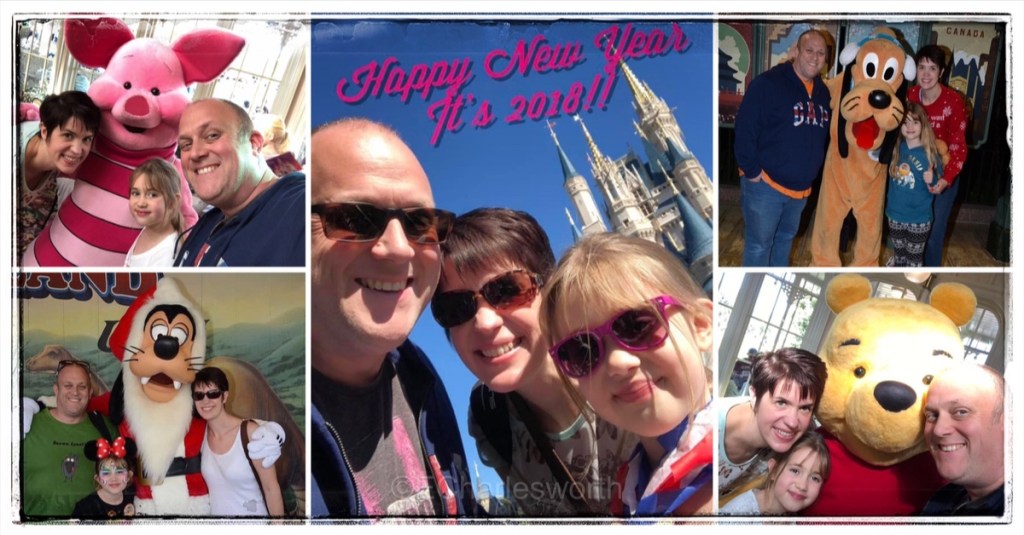
You’ll probably be surprised to learn that this is a blog about my mental health given the pictures from Disney World at the top of it. But there’s a reason for including those. Because it was during this holiday that everything came to a head. I vividly remember storming out of our hotel room on more than one occasion. I vividly remember slamming the door behind me and telling myself my marriage had three months before I gave up on it. Yes, that’s right. In the happiest place in the world, I was miserable. My family were miserable. There were arguments most days. Yes we glossed over them and were able to have a nice time, but they were still happening. And what was the cause of most of these arguments? That things were going wrong, it wasn’t the holiday it was meant to be due to the weather, over tiredness and a lot of external pressure. And when it wasn’t perfect, I couldn’t cope. Because I’d put so much pressure on myself to deliver this perfect holiday that I felt the need to exacerbate every little thing that went wrong. I made it worse. No, Mr C wasn’t an innocent party, but I made things worse. I mean, just look at the photos, you can tell that things were strained, can’t you?
The simple answer to that question is no. Because despite the fact I was spiralling into a darker and darker place mentally, I wouldn’t talk about it. I became so adept at putting on a mask and pretending I was fine. I put the holiday photos on Facebook. I made sure that we were all smiley and cheery. To the outside world, Family Charlesworth had just had the perfect dream holiday in Disney World over Christmas. No-one knew what was really going on behind closed doors. And for a long time, I viewed this holiday as the start of my falling apart, despite the fact I had not been right for months prior to it. Yet Mr C later told me he viewed it as the start of my recovery because it made me acknowledge something wasn’t right. It took me a very long time to be able to look back on that holiday and not view it badly. I can do that now. I can look back at the photos and smile. I can look back at the 100-page photobook Mr C painstakingly put together for us and talk to my daughter about the memories that make us happy and laugh. Because it was a good holiday. I was just so blinded and in such a dark place that at the time I couldn’t see it. I focused on the negatives. When people would ask me about it, I couldn’t muster any enthusiasm for it. I would respond with “it was fine thanks”, “we had a nice time” or some other inane response but despite this, I still didn’t want to front up to how I was really feeling.
It’s why it took me a further six weeks after we returned before I made the decision to seek help. Not because I was afraid to, but because I had just accepted that feeling this way was normal. I just felt that talking to someone about what I was feeling (the constant exhaustion, the flying off the handle at any given moment, the inability to make a decision) was one more thing to add to the to do list. I didn’t have the energy. I’d have to deal with it then. Far easier to lead a miserable, exhausted life, than face what was going on. But after one argument too many, after getting just that one step closer to walking out, I gave in. I accepted I needed to talk to someone. I knew I didn’t want to end my marriage, it was just being a wife was just one more thing that I didn’t need to be doing. My marriage was always the first thing to suffer because everything else was prioritised on top of it. I just didn’t have the energy to put the effort in to that as well. I took it for granted that it would always be there.
And so, without telling Mr C I was going to do it, I picked up the phone and made a call to our Employee Helpline. I felt scared. Because I knew this was bad. I knew as they asked the questions and I answered truthfully that they weren’t going to put the phone down having told me to go away and that I was fine. I wasn’t. I knew that. But what I couldn’t get my head around was why, who needs counselling and help so that they can cope with everyday life? You see I’d had counselling three times previously but in my head, each time was for a valid reason. The first because I’d buried a lot since my childhood, my parents’ divorce and Mr C’s diagnosis and treatment for cancer. The second because I was going through a tough time at work and was struggling with a two-year-old, I never felt good enough. The third because I’d buried a lot of feelings after we experienced a missed miscarriage. Reasons. All valid. To ask for help because life simply felt too hard felt ludicrous to me.
But to talk to me at the start of 2018 when I was at my lowest, you would not have known just how bad it was and how much I really did need help. I didn’t want to tell people in case they perceived me as weak. Two people knew at work, and I was so lucky with the support they gave me, but I didn’t want them telling anyone else. I didn’t tell many family members. I told barely any friends. I look back now, and it makes me feel sad for Mr C. Because I don’t know if he ever spoke to anyone about what was happening. It must have been so hard for him to be living in that situation. It’s one of those things I always thought we’d get around to talking about, but we ran out of time. I hope he did talk to someone. I hope he felt supported. Because I can only begin to imagine how hard it was for him to watch his wife fall apart in front of his eyes for a number of months.
And then as I was coming to the end of my counselling, the Friday of Mental Health Awareness Week, 18 May 2018, my father in law said something to me which would change everything. He was paying me a compliment. He was giving me a little boost. But what he didn’t realise was that he was about to change the way I approached my life. In saying what he did, he unlocked something in me. It’s why I remember the date. What did he say? “You’ve got broad shoulders; you’ll just take it all on the chin. It’s what you always do.” He was right. To onlookers this is what I did because this was the facade I’d created. Emma Charlesworth could take on anything and it was all water off a duck’s back. She was strong. Yet as I left his house a little while later and sat outside my daughter’s school, I reflected on what he said. This really was the perception of me. And the only person who was going to change that and admit I couldn’t take it all on the chin was me. I’ll always be grateful to him for saying it, without it, I don’t know when, or if, I’d have started being more open. So, as I sat outside my daughter’s school, I wrote social media posts. I still wasn’t brave enough to tell people face to face, so social media felt like a way to dip my toe in the water. I shared that I’d been having counselling. I shared that I’d been living with depression and anxiety. I was staggered after these posts went live. No-one judged me. No-one called me weak. The support overwhelmed me. It really was ok that I was admitting that I wasn’t ok.
Over the following 18 months, I started sharing and to open up more. I became adamant that our daughter would not grow up thinking it was weak to ask for help. I would set a good example for her. I would make sure she always felt comfortable to talk about her feelings. But most of all, I didn’t want to wear a mask and put on a front anymore. I just wanted to be me. To be accepted for who I was, warts and all. In February 2020, just a month before he fell ill, Mr C recorded a video of me sharing my story for the internal news platform at work. He was so proud of me for doing it. Because for just over 20 years, this is what he’d wanted me to do. To just be me, to not pretend to be someone I wasn’t. To simply be Emma. Someone who struggles with life at times, someone who on occasion needs help to deal with life. Someone who isn’t perfect but is happy with herself regardless of this, because no-one is. But no matter what, she’s someone who refuses to give up.
He’d be proud that I can sit here now and reflect on all of this. He’d be proud that over the last few weeks I’m noticing things which could be little triggers indicating that I need to be a bit kinder to myself. I’ve started to wonder whether my inclination to open the laptop and work once my daughter has gone to bed really is because the work needs doing then or because it’s a distraction technique to stop me feeling lonely and being alone with my thoughts. When people ask me how I am, I’ve realised I tend to respond with what I’m doing to help my daughter and how she is. Again, I’m distracting because to think about how I am is just too hard. I don’t honestly know how I am. It’s raw. It has the potential to unlock something within me which I’m not ready to face yet. I can feel the emotion rising during conversations where I feel frustrated or disappointed, I’m not able to keep it under wraps. The Emma tone of old creeps in. Being hugged by a couple of people in the last few weeks (yes, I know rules have been broken here) made me feel fragile. I wasn’t ready for physical contact. The thought of the return to a post lockdown world makes me feel vulnerable. I’m still grieving, I’m still trying to process being widowed at 39, I’m still trying to adjust. I will be for a very long time. I want to hide away from people for a lot longer. And while I have had bereavement counselling to help me work through the immediate trauma of what we went through, I know at some point I’ll seek more. But I know that by recognising these triggers and understanding myself, it means I won’t hit rock bottom before I do this. I won’t ever allow myself to hit rock bottom again. Because the difference between now and 2018 is that I’m not scared to ask for help. I won’t be scared to tell people.
Why? Because of what I’ve learnt over the last four years, because I can now accept that asking for help doesn’t mean you’re weak. I ended a previous blog with a quote from Winnie the Pooh and this one is no different. Because one of the best quotes of all when it comes to mental health comes from Piglet. “It’s okay to feel not very okay at all. It can be quite normal, in fact.” Never a truer word spoken.

 Life is a rollercoaster