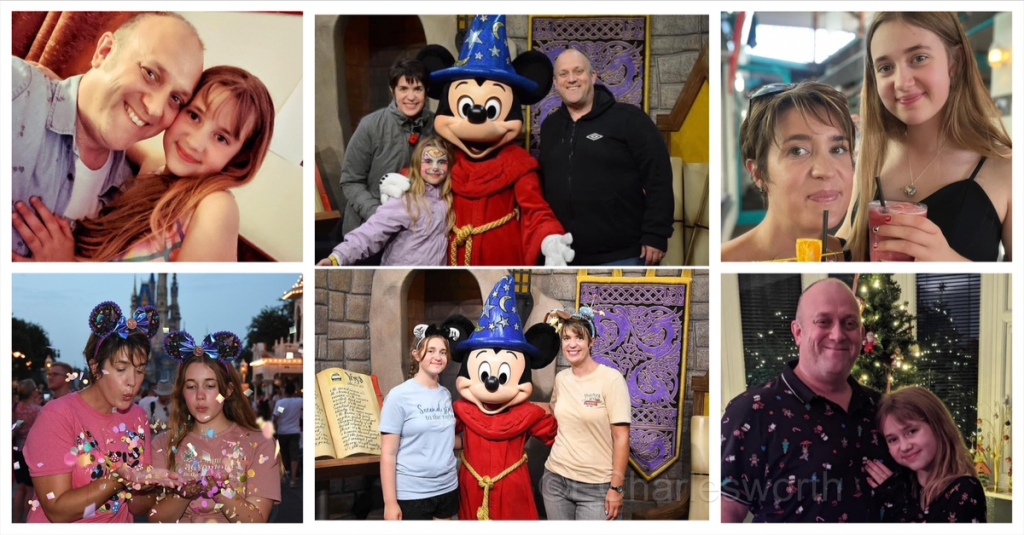
I want to start this by saying I’m no expert on grief. I’m no expert on bereavement. I’m no expert on childhood bereavement. But what I am an expert on is my child. My child who, at the age of 10, watched as her beloved father grew steadily weaker and more ill because of COVID-19. Who watched as her father walked out of our house to an ambulance accompanied by three paramedics. Who then never physically saw him again. Just think about that for a moment. It’s not fiction. It’s real. This is what happened to my beautiful, clever, amazing 10-year-old.
One of the very first things that was said to me in amongst all this carnage was “children are resilient.” It was said in a way to make me feel better, to make me feel that she would be ok despite our world crumbling around us. It wasn’t meant with any malice at all, because fundamentally children are resilient in a way that is different to adults. They are far more black and white, they are far more pragmatic, they see the world in a different way to us. But over the last two and a half years, this phrase has come back to haunt me time and time again. Because I can’t help but wonder if we are actually doing children a disservice by using this phrase and immediately telling them and their families how resilient they are. Yes, they might be, but that doesn’t mean that they don’t suffer, that they don’t feel pain, that their lives aren’t ridiculously changed forever, that they aren’t ridiculously changed forever. And quite simply, this is what has happened to my daughter.
She was a relatively carefree 10-year-old when the pandemic came into our lives. She was never meant to have been an only child, but after Mr C’s cancer we didn’t even know if we’d be able to have a child, and then after my miscarriage, we decided to just be thankful for the child we did have and that was that. I’ve wondered on more than one occasion how different her experience of bereavement and grief would have been had she had a sibling to share the pain and the loss with. It’s one of those “what if” questions that should never be asked and will never be answered.
And while I say carefree, she hadn’t always had it easy. She’d had to watch me hit rock bottom at the age of eight. She’d had to watch my nan’s health decline due to Alzheimer’s from the age of six (just six weeks before the diagnosis, she’d still been having sleepovers with my nan and baking cakes). She’d seen the usual marital arguments that happen. But, overall, she didn’t really have that much to worry about in her life. We tried to make as many memories with her as possible, we knew that she would only be a child for so long and that we needed to make the most of our time with her. I will be beyond grateful for the rest of my life that we took this approach and have a wealth of memories and photos to look back on.
But as the pandemic seemed to grow in its severity, the biggest worry and challenge I thought she was going to face was that of isolation, of not being at school, of not being able to go to dance lessons, of not seeing her friends and just being stuck with two adults in the house. But I didn’t worry too much, because children are resilient… Little did I know what she was actually going to face. I will never, ever forget the early hours of 30 March 2020 when she woke up to hear her father struggling for breath, me making a 999 call and seeing the utter panic and desperation I felt. Yes, I tried to say calm for her but in that moment I’m sure she saw it. She knew. And then, in a reality that will forever pain me, I had to leave her on her own when the paramedics arrived because they needed me. My 10-year-old had to sit on her own in our lounge, whilst knowing that upstairs people were trying to save her father and the only comfort she could get was via my mum on the phone because no-one could come in our house. But that’s ok right? Because children are resilient.
The next three weeks sort of passed in a blur. There were days we didn’t make it out of our PJs. There were days we’d have cake for breakfast and brownies for lunch. There was the day a week before he died when I had to sit her down and tell her that he was very poorly (understatement of the year) and might never come home. “Do you understand what I’m saying?” I remember saying to her. “Yes, you’re saying daddy might die” was her response. Pragmatic. Real. She was bloody amazing. And then the Skype calls came. I didn’t do the first one with her because I wasn’t sure what he’d look like but having done that one, I knew she’d be ok seeing him. Each day I would ask if she wanted to talk to daddy and her response was always “well, I’ll talk to him today because he’s here today isn’t he and might not be tomorrow.” I told this story when I was on a panel at the UK Commission on Bereavement “Bereavement is everyone’s business” report launch and you could hear a pin drop. I saw members of the audience crying. It hit me then. Just how much I’ve come to accept what we went through because we were living it. How I’ve probably downplayed our experience because it was ours. And yet when other people hear it, they consider it heart-breaking.
But. The attitude and philosophy that my daughter adopted during that final week kept me going, because if she could do it, then so could I. And then the fateful day came. The call came. Hope had gone. He was going to die. She was actually about to become a child whose father had died. My biggest fear had been realised. Again, we did a Skype call and this was our chance to say goodbye. I can still remember her saying to him “I’ve not really got anything else to say to you now, I haven’t done much, I’ll go talk to nana and come back in a bit” (my mum was sat on our driveway at the time). Because let’s face it. Children are resilient. This was just something else she was dealing with.
And let’s be honest. She didn’t really have a choice but to deal with it. We were living in the middle of a global pandemic. Her father had died. I couldn’t make this any better for her. I couldn’t pretend it wasn’t real. Both of us had to deal with it. But unlike me, she didn’t cry. For weeks, if not months, she didn’t cry. She queried this with me because she didn’t understand why not. “Everyone grieves differently, please don’t worry about it” was my reply. It was all I had. The day of the funeral, she didn’t cry. She stood in the crematorium, did a reading with me, and didn’t cry. Shock. That’s what she was experiencing. Shock. I didn’t really realise it at the time, but like I say I’m an expert on my child and now I can say she was in shock. She was in shock for such a very long time. My amazingly brilliant, resilient child had experienced pain that no child should ever experience. She not only experienced loss, but went on to experience isolation, a lack of physical contact, her mother falling apart and secondary losses. Yet all the while people kept telling me that she’d be ok. Because children are resilient.
What I hadn’t really realised at the time and didn’t really realise until this year is how she aged overnight. Not just mentally, but physically. Her eyes took on a sudden weariness. She looked older. Yes, partly because she was growing up, but also partly because of the trauma she went through. And I realised this in the simplest of ways this year. We went to Florida for three weeks; it was our treat to ourselves after the heartache we’d gone through. We did a day trip out of the parks one day and she asked me for a cuddly toy as a memory, before then I couldn’t tell you the last time she asked for one. On the coach back to the hotel, she cuddled that toy. I snapped a photo and sent it to my sister. “She looks so young” was her response. And that was it. That was the moment I saw it. Our three weeks in Florida enabled my daughter to be a child again, to not have a care in the world and ultimately, to regress. She got back a little bit of her childhood on that holiday. I cried on the plane on the way home, partly because I felt I was leaving Mr C there but also because I felt I’d got my little girl back. She had been given the space and ability to be a child again. It was a momentous feeling. I wanted to keep her like this forever.
But back to reality we came. She said something to me a couple of weeks later after a difficult few days and it just winded me. “People don’t ask me how I am anymore, it’s been over two years, I’m supposed to be ok with it now aren’t I?” Because time is meant to be a healer, isn’t it? But sadly, the misconception that exists because we’re “trained” to believe that children are resilient is that they don’t suffer for any length of time. That they just bounce back from whatever comes their way. That they don’t experience pain in the same way. That grief doesn’t affect them. Without question it does. And it’s something that will be a part of them forever. I wonder how we can change that, because in my opinion it needs to be changed. Unless you’ve witnessed it first-hand, you have no real idea of what grief, trauma and pain can do to a child.
I won’t talk about all the ways I can see that she’s been affected and what it’s like for her because that’s her story to tell and I don’t want to divulge it. Maybe one day, but not now. Not while she’s living it. But what I can tell you as her mother is that she is 100% affected by her loss. That she is 100% struggling to work through and process what has happened to her. Losing her hero. Losing her protector. Losing one half of her history. And quite simply, why wouldn’t she be? It doesn’t mean she’s not resilient, it just means she’s human. It just means that she’s experienced one of the most awful things that she possibly could, and she needs to be allowed time and space to work through it. She needs love and care. She needs people to ask her how she is. She needs to talk about her dad. She needs to know that all of how she is feeling is ok.
And interestingly enough, from my perspective, it is this that I believe will build her resilience and help her as she goes through the teenage years and adulthood. Needing help doesn’t mean she’s not resilient, that she’s mad, that she can’t cope or that she’s weird. It just means she’s human and vulnerable. And I will be there with her on every step of this journey. I am so grateful for the child bereavement charities that I’ve spoken to who have given me guidance, who have supported her and will continue to support her.
But most of all, as her mother, I couldn’t be prouder of her for the way she has responded over the last couple of years. It’s not been easy; I’d be lying if I said it had. But I hope that she’ll retain the human and vulnerable elements to her as she gets older, because they’ll be two of the most valuable qualities she’ll ever possess. I hope that her experience doesn’t define her but instead helps shape her. To help her go into adulthood retaining that realistic and pragmatic view on the world. To truly understand that being resilient doesn’t mean that you don’t find things hard. That you don’t suffer. That it’s ok to need help now and then. And without question, I know that if she takes this into adulthood, it’s something that her dad would be very proud of her for doing too.

 Life is a rollercoaster