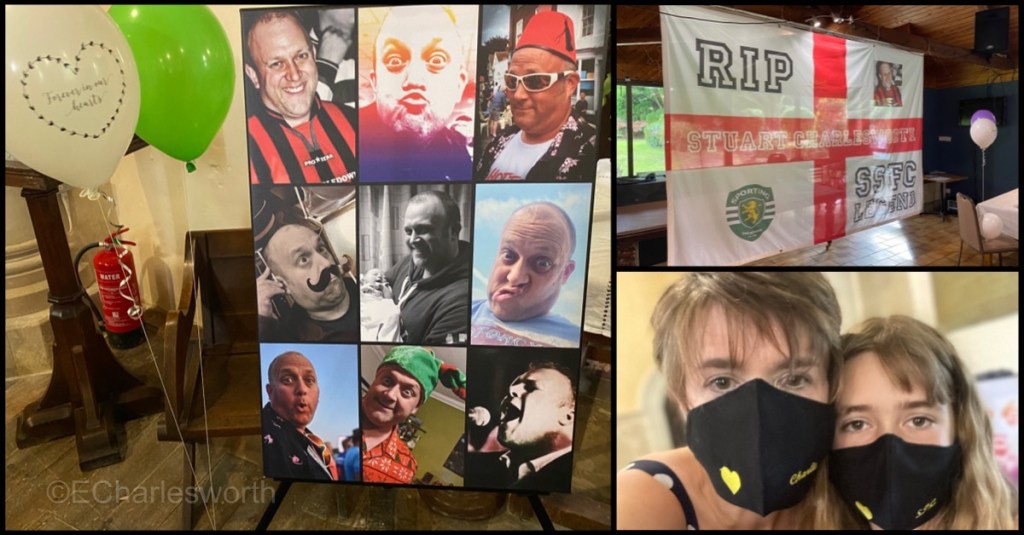
Yesterday would have been Charlie’s 47th birthday. It was the perfect day to host his Memorial Service and Celebration of Life. I thought about writing a blog for the day but then realised the speech I read said pretty much everything I wanted to say. And I even managed to make it all the way through in one piece!
Well, it turns out there’s a reason I write instead of speaking. It’s actually quite intimidating to stand here and see you all today. But hey, I’m going to give it a go. And please bear with me. As an aside, there are tissues provided on the table and this is your disclaimer that you may need them! Charlie got everyone with his speech at our wedding, so now it’s my turn.
Firstly, I wish we weren’t all here today. In the nicest possible way, I wish we weren’t all here. But we are and we all know why. We’re here for a very good reason. To remember and to celebrate my husband. Stuart Peter Charlesworth. “Charlie”. I still find it surreal and unbelievable to use the phrase “my late husband.” so I don’t tend to. Because let’s be honest, he was never late! I equally still find it difficult to comprehend what’s happened, and if I’m completely honest, I probably never will.
I have gone through every emotion possible since ringing 999 in the early hours of my 39th birthday. Since I saw the fear in his eyes. Since I saw the panic on our daughter’s face. There are days I go through every emotion possible in 24 hours. Losing him is a pain like nothing I have ever experienced before. It is something I pray I never have to go through again.
But today isn’t about me. It’s about Charlie. A man I first met nearly 25 years ago outside Central Park, the home of Sittingbourne FC. He was stood by his blue fiesta and I had no idea then the role he’d gone on to play in my life. I remember sitting in Steve and Libbie’s lounge a few weeks later listening to him say he wasn’t going to go to a Bryan Adams gig because there was a chance it would be Sittingbourne’s last ever game on the same day and he needed to be there. Because that was Charlie. Dedicated and loyal. To know him was to love him, to know him was to be loved by him. Whether you’d known him for a few months, years or a lifetime, it didn’t matter. He treated everyone equally. When he came into your life, you felt it. Now, don’t get me wrong. I’m well aware that he’ll have frustrated all of us at some point or another with his rule master behaviour, rolling his eyes, his tendency to always want to be right (yes, really), and some of his Charlie-isms. But when I look back now, these tend to pale into insignificance. The impact he had on each and every one of us in this room ultimately comes down to love, friendship, authenticity and laughter.
When I see everyone here today, I feel humbled and overwhelmed that you all made the effort to be here. For him. For me and Rebekah. I can’t thank you all enough for doing this, I know so many of you were added at short notice because of the change in guidelines, but it didn’t matter. You wanted to be here and that means the world to us. For those of you who’ve had to travel some distance, I appreciate it more than you’ll ever know. Charlie would be so, so honoured at the effort you’ve all gone to, so thank you.
I look around this room at how all aspects of his life are represented. And the people who are here show what a full life it was. Childhood friends and their families, his bands, Sporting Sittingbourne, family, friends. I really do thank you all for being here with us today to celebrate him. But also, two amazing people who were due to be here but unfortunately illness meant they couldn’t be. Two amazing people who I only got to know because he fell ill. Two people who were there for Rebekah and me during the agonising days of ITU, two people who become our lifeline for a week. Our Skype angels, Mel and Sharon. I’ll never be able to repay you and the rest of the ITU team for all you did and continue to do for us. Thank you.
And without wanting this to turn into an awards acceptance speech, I do have some other thank yous! None of these people are here today, but I want to say thank you and acknowledge in front of you all the role that my colleagues have played over the last 15 months. They’ve seen me at my best, they’ve seen me at worst. They’ve supported me throughout, they’ve seen me via online meetings way more than friends and family, they’ve dealt with my tears this week on calls and listened to me rehearse this speech. They really have been a fundamental part of the scaffolding that’s held me up.
And now for the tough part. To thank people who are here today. To Rob for your tribute. Just perfect. Thank you to Elliott for always overthinking yet still managing to deliver a great reflection. To James for your reading. It was just so right to have you all speak, Charlie would have known how hard it would be for you all but been so honoured that you all said yes. And once again, I’m indebted to you Estella. For the time you gave helping me organise the church including the seating and social distancing. For the beautiful service. You did it at his funeral and you have done it again today. I don’t underestimate how much of a challenge this would have been for you on both occasions, I’m so very, very grateful.
But in addition to today, I know Charlie would be so grateful at how so many of you have been there for his wife and daughter in the darkest time of their lives. Who have picked me up off the floor (both literally and metaphorically), who have picked up the phone or sent messages, who have been there without judgement, who have appeared on my doorstep with a Costa when you’ve text and I’ve said I’m having a bad day, who have turned up with gin and hair dye to stop me stressing in advance of his funeral, who have cooked us meals, who have looked after Rebekah, who have let me break down on them when it all gets too much. Thank you. You all know individually the role you’ve played, how you’ve supported us and how you’ve been there for us. I simply can’t detail it all. But from the bottom of my heart and I’m sure his, thank you.
I also want to thank the person Charlie always said was his greatest achievement. Our greatest achievement. Our beautiful, brave daughter Rebekah. You astonished me when you spoke at his funeral last year and have done it again today with singing for him. But more than that. Quite simply, I would not still be standing without you. You have been my reason for getting out of bed every single morning for the last 15 months. You have inspired me to keep going. Earlier this week when I said I wasn’t going to come today because the enormity of it all hit, you were the one talking sense into me. Just like daddy would have done. Without a shadow of a doubt, you have been phenomenal. I am so unbelievably proud of you. Daddy would be so unbelievably proud of you. Everyone in this room could learn so very much from you and how you have coped with losing your dad at the age of 10, I know I have.
But the biggest thank you I have to say is to Charlie himself. I think back to the last night he was at home. When I asked if he wanted me to stay with him while he shaved, he said no, so I trundled downstairs, finished the ironing and watched my Jason concert. No way Jason wasn’t going to get a mention in this speech! But in all seriousness, if I had known what was going to happen six hours later, I’d have sat on that bathroom floor. I’d have talked non-stop at him. He’d have absolutely hated it! I’d have said thank you. I’d have thanked him for the love he gave me for over 20 years, for the love he gave our daughter, for the laughter, for the influence he had on us. For being my wingman when it came to parenting. For the fact that it’s down to him that a number of you are in my life. For always taking and twiddling the photos, for introducing me to new music, for teaching us board game rules. For so much more. But most importantly, for the lessons he taught me, that it’s ok to be me. That I don’t need to be perfect, I just need to be me. Warts and all. For teaching me that I don’t need to conform, that people either accept me for who I am or they don’t. And that’s ok. I don’t need to change who I am to fit in. If I had the night of 29th March 2020 all over again, this is what I would say. Thank you Charlie. For everything.
It is a cliché to say he is always with us, but he really is. The music we’re listening to today are the songs that people told me reminded them of him and make them smile. I’ve turned it into a Spotify playlist so you can all share those memories. The seeds on the table that you can all take and plant in memory of him. Wherever you like, scatter them at his bench, scatter them in your garden. Wherever. Just do it to celebrate and remember him. He loved a wildflower and helping the bees, so again, it helps him live on. The memory cards that are on your table. Write your memory, funny, sad, thoughtful. Again, just share this. It’s all part of keeping him part of us. I vowed to him on the day he died that I would never, ever let him be forgotten. Yes, Rebekah and I are having to move forward with our lives, but I know that he will be a part of mine for as a long as I live. He will be a part of our daughter’s life for as long as she lives. And I hope in some small way, he will and we will continue to be a part of your lives too.
So. I’ve made it. Just. Please, please carry on smiling today. Take the photos, make the memories. You know it’s what he’d have been doing. When you watch the Euro final tomorrow, think of him. He’d have been loving this tournament. And as for making the final over his birthday weekend. It’s what dreams are made of. Only one other thing to say really before I wrap up. It’s coming home.
And finally, I’d like to ask you all to stand, to raise a glass and to toast Charlie, Dad, Stuart, Son, Bro. Whatever you called him, just raise that glass and make that toast. To Charlie.


 Life is a rollercoaster