Recently, someone shared a video in the Widowed and Young group on Facebook of an interview which Martin Lewis had done a few years ago. In it, he spoke about the death of his mother and how that had affected his life. There was one phrase that really hit me “that was the end of my childhood.” I was sat in the car park of our local Dunelm at the time of watching and it just made me sob. And made me think about my own child. It made me realise something that I’d not really thought about before. I’m the mother of a child whose childhood ended at the age of 10.
Because it really did. Yes, I’ve done my very best to keep things as “normal” for her as possible. Yes, I’ve managed to make it possible for her to keep doing a number of things she did before the death of her father. But the simple fact is, she has been exposed to the harshest of realities. She grew up, essentially, overnight. She lost a parent. One half of the team that had been keeping her safe and protecting her for 10 years disappeared. The person who had got her up every day. Her hero. She lost him. In the most surreal of times.
Of all the people who are grieving the loss of my late husband, it is my child that my heart breaks for the most. Even more so than for my own loss. Because as I look at it, I was fortunate enough to have known him since I was 15 years old. I’d been in a relationship with him since I was 18. He’d been in my life for over 20 years. I have so many memories of him. I had so many experiences with him. We’d done so much together. All that potential has been stolen from our daughter. She no longer has a future with her father. Studies have been done as to what age children start having memories from, and the general consensus is that it’s around seven years old. That means she has just three years of memories with her dad. And they’re meant to last her a lifetime. Except they won’t. Because it’s only natural that other things will come into her brain and start to replace them. Yes, she’ll remember things (I’m not saying she won’t) but if I was to sit here now and talk to you about my life between the ages of seven and 10, how much can I really remember? Not a huge amount.
I listen to her say that when she’s 20, her dad will have been dead half her lifetime. I watched her sleep in my bed for 18 months after he was rushed to ITU because she was so terrified that something was going to go happen to me too. I watched her completely struggle with Christmas last year, because the magic of it had gone (her first year of not believing) and the reality of her dad not being here at Christmas was too much for her. These little things remind me that she is actually still a child. A child in pain. But when I think back to that Martin Lewis interview, there is so much of her that I’ve seen that feels as though her childhood is over.
When she’s been sent messages that, in my opinion, should never have been sent to a child, she was the one who wanted to write the responses. She didn’t want me step in and deal with them for her. And respond she did, in the most eloquent and articulate of ways. I was so, so proud of her. But at the same time, my heart broke that tiny bit more, because I knew I hadn’t been able to stop the hurt she was feeling because of it. I knew I couldn’t make it better for her. My role as her mother is, and always will be, to protect her and try to stop heartbreak. I spoke in my blog on Mothering Sunday last year about how much of a fierce Mama Bear I’ve become. But over the last year, I’ve had to make sure I don’t unleash the Mama Bear too often, because my daughter has become more ready to take on the next battle herself. Partly this is due to her age, and the transition to secondary school, but also when your heart has been broken in the way hers has, you’re not really afraid to take on the world. You’re not really afraid of anymore hurt because, to a certain extent, it feels inconsequential compared to what you’ve gone through.
She’s also become so very much more adult like in her interactions with me. I still have to remind her on a regular basis that she is a child, and needs to do as she’s asked, but the crux of the matter is that she has had to step up these last two years. She was the only person in the house with me for such a long time after my late husband died. She has had to physically help me get up off the floor. She has watched her mother fall apart and break on more than one occasion. She has been the one to frequently see my tears and ask “why are you crying mummy, what can I do to help?” She is the one who has given me pep talks and reality checks when the going has got really tough. She has, to a certain extent, become a carer for me. Not out of choice, but because she is the only one living with me 24/7 and seeing the pain I’ve been living with. She is the one who has stepped up to do chores to get pocket money and sell her decoupage items so that she can save money to buy me presents for Mothering Sunday, Christmas and my birthday. This was pretty much dealt with for the first year, but she now feels it’s not fair on my sister or my mother to buy presents on her behalf anymore. She feels a responsibility. A responsibility to not only look after her mother, but to provide for her when needed too. All this at the age of 12. It’s no wonder that I feel that I’m a mother to a child whose childhood has ended.
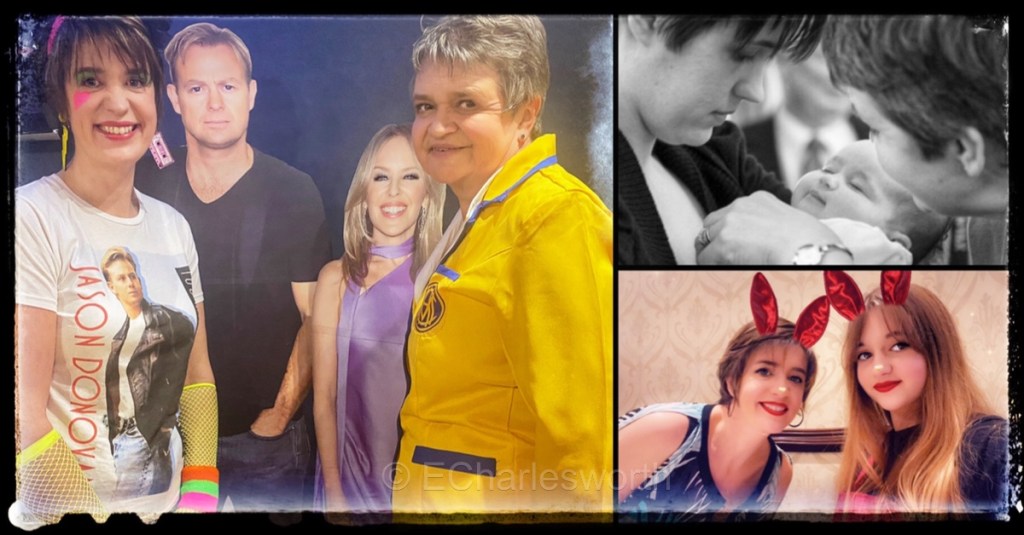
I look back at my own childhood. To a certain degree, I wonder if this is what my mother felt after the breakdown of her marriage. Because I know that I had to step up then too. I helped look after my sister, so my mother was able to do things. Not least of which was doing three jobs. I don’t know the full financial implications and arrangements following my parent’s divorce, I didn’t need to at the time, I was a child after all, but I do know that my mother did three jobs so that she was able to continue to treat us. She wanted us to be able to go on holiday or to concerts (she possibly regrets that now though given my Jason Donovan and my sister’s Boyzone obsessions!!) I will always be beyond grateful to my mother for everything she sacrificed and did for us when we were growing up.
I can’t help but wonder what it must have been like for her when she had to watch her eldest child tell her child that her father was going to die. Heartbroken and helpless is all I can assume. Because I don’t think there ever really comes a time when your child is not your baby. I say to my own daughter that she’s my baby and she responds with “I’m not a baby.” No. She isn’t. But she is my baby. And she always will be. My mother would probably tell you that I’m her baby. Over the past two years, I’ve watched her try to do more and more for me. Despite me saying “I’m nearly 40 / I’m in my 40s / I can do it myself.” She felt helpless for so long because of the restrictions in place, that I suspect there’s an element that now she can help, it helps her to help me. She gets cross when I don’t wash my car, so takes it off my drive and does it for me. She’ll turn up with my stepdad when he mows the lawn to do some gardening for me. When my washing machine broke earlier this year and the repair took longer than anticipated, she did all our washing. And would regularly bring it back ironed. She’ll cook us dinner if I’ve got a particularly hectic schedule. She helps out with my daughter and our puppy so that I’m able to go to the office or have nights out. Put simply. I would not have been able to achieve or do half as much as I have without her since I became a solo parent.
And this is against a backdrop of some fractious times. It hasn’t always been plain sailing between my mother and me. There may well be other challenges in the future. But it comes back to a mother’s love and what being a mother means to you no matter what the circumstances are surrounding the relationship. My late husband hadn’t spoken to his mother for many years before he died, and neither had I, but I will still acknowledge the pain she must feel. It’s why I’ve made sure I’ve sent her copies of photos, newspaper and magazine articles, in the same way I have for his father and his sisters, because, at the end of the day, she is a mother who has lost her child. She in return has written to tell me how proud she is of her son and to thank me for all I have done to keep his memory alive and to honour him. She will always be his mother. His death won’t that change that.
I can’t begin to comprehend and don’t claim to know what it must feel like to lose your child. I realised recently that my own daughter is now the age my cousin was when she died, and I felt like the rug had been pulled out from under me. Because I simply can’t imagine how I’d feel if my daughter’s life ended now. It goes against the natural order of things. When you become a mother, it isn’t something that you ever contemplate. I know from my own experience that I hadn’t expected to feel the unconditional love I do for my daughter, but I also know that I hadn’t expected the constant fear and worry that goes with being a mother. There is nothing I wouldn’t do in order to protect my daughter. From anyone and anything. And the knowledge that I can’t actually protect her from everything is heartbreaking.
But I also know that because of everything she’s gone, and continues to go through, she’s growing up with a very realistic outlook on the world. And maybe that isn’t such a bad thing. I recently came across the Facebook post my late husband posted on Mothering Sunday 2019. It came after a particularly trying weekend. He said:
“You are a fantastic mother, so, if nothing else, take from today that achieving that accolade is not purely down to making your child happy. It is about teaching, guiding, encouraging and sometimes pushing your child to understand what it is to show compassion, kindness, respect and love, even if it, at times, feels like it is at the sacrifice of those things for yourself. This is why you are a great mother and why one day, you will reap the benefit of the seeds you sowed.”
I’ve had to continue to teach my daughter compassion, kindness, respect and love in a way that I know he wouldn’t have anticipated when he made that post in 2019. I’ve sacrificed so very much of myself these last two years since he came down with his temperature on Mothering Sunday 2020. I’d do it all again in a heartbeat, because that is my role as a mother. But as I sit here now, I know that I can start to give a little bit of attention back to me because of the amazing person my daughter is becoming. I can’t properly articulate just how proud of her how I am. In the same way, my late husband’s mother is proud of her son. In the same way that my mother is proud of me. I have a child who makes me beyond proud. Every single day.
I know that she won’t let the death of her father beat her. When I watched the Martin Lewis interview and how he credited some of his success to the loss of his mother, I envisage in years to come hearing my daughter say something similar. She tries every single day to better herself. She has the steely determination of her father. She shows so much dedication to music, drama and theatrics, I’d put money on me one day watching her on a West End or Broadway stage. And whatever her future brings, I know that when I watch her achieve, I won’t feel the heartbreak anymore that her childhood ended so young. I’ll just feel enormous pride that the experience and hurt didn’t define her. That she used her experience to help her become the person she wanted to be. And as her mother, I won’t be able to ask for anything more.
 Life is a rollercoaster