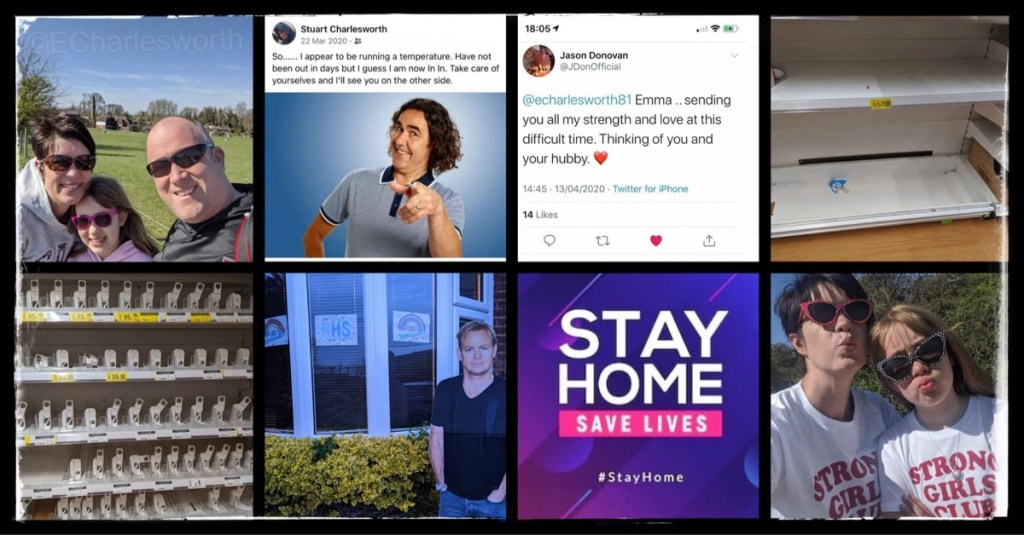
Cast your mind back to this date five years ago. Can you remember what you were doing? Probably not. It’s a pretty insignificant date really. 9 March 2020. It means so little to so many people. I can’t really remember what I was doing other than knowing I’d have been at work. I went back and looked at my work calendar as I started writing this. I started out in one office, travelled to another office to have a lunch with a member of Alumni network and a colleague and then worked from a different office for the rest of the afternoon. No doubt I then went home, did some bits with my daughter, had dinner with my husband and probably did some chores. Before I got up and did it all again the following day (with the exception of the lunch).
Except. I do remember one of the topics of conversation over that lunch. I remember talking about a conversation I’d had with my husband two days previously in our local supermarket regarding buying some chocolate. “I really fancy some chocolate,” he said, and I merely responded with “Go for it. Pop it in the trolley. If coronavirus doesn’t get us, the asteroid that my colleague told me about will.” This was the topic of that conversation at lunch and a number of conversations with family, friends and colleagues. Coronavirus. Pandemic. COVID-19.
Did any of us really anticipate quite how long we’d be talking about this for when we first started discussing it in early 2020? The impact and devastation that it would cause? The complete and utter changes to our lives as we knew them? I, for one, didn’t. Maybe I was naïve. Maybe I was delusional. Maybe I was just clinging to hope. It definitely wasn’t down to the fact that I wasn’t taking it seriously, it’s just because it felt impossible that the UK was going to be hit hard. I didn’t understand and couldn’t really begin to process and fathom living through a pandemic in my lifetime.
The following week, on 16 March 2020, I was on a call with work on my way home, planning how we were going to organise our team to avoid us all being in the office at the same time, when the then Prime Minister of the UK, Boris Johnson made the announcement that, if people could, they should work from home with immediate effect. I sat on the train, almost dumbfounded. This was really happening. The pandemic was beginning to affect my day-to-day life. It was going to affect my family. I worried about the impact on my daughter and her mental health.
Over the course of that week, it was confirmed that her dance lessons and summer show were to be cancelled and that she would not be going to school as of Friday, 20 March, I couldn’t tell her how long this would last. I had no idea just how serious and horrible it was going to get. And I vividly remember her looking at me with the innocence of a 10-year-old and asking a question that I couldn’t really answer. “Why did this have to happen?”
Were similar conversations going on in my friends’ houses? In my family’s houses? Across the country? Across the world? We weren’t special, I was pretty sure of that. But by the end of that weekend, we did become special in a way. Because on 22 March 2020, my husband started sporting a temperature. He updated his Facebook status with an image of Mickey Flanagan and the words “So…….. I appear to be running a temperature. Have not been out in days but I guess I am now In In. Take care of yourselves and I’ll see you on the other side.”
Reading that back still sends chills down my spines. Whenever people use the phrase “I’ll see you on the other side” my stomach drops. I have to ask them not to. Because little did we know how significant his post would become.
We became special on that day because this was the day when we suspected COVID-19 had entered our house. I didn’t know of anyone else going through this experience. Family. Friends. Colleagues. No-one else was suspecting it was in their house. If we weren’t living with it, I might have struggled to believe that what I was seeing on the news was actually real. Just watching the news reports, seeing the headlines, hearing the numbers of people in hospital, the numbers of people dying and knowing we were living through a pandemic, did, and still does feel surreal.
My daughter asked me why this had to happen. I kept asking myself how this had happened. The UK is an island. How on earth had we allowed this airborne virus to enter our country? To begin spreading like wildfire. Why had more not be done to stop it? How? Why? Two words that would repeat themselves in my mind over and over again. They still do in a way. I’m not a vituperative person by any means, but five years on, I still cannot fathom how and why the UK was allowed to be affected as much as it was. I openly admit I don’t do politics in my writing, but I do have incredibly strong views on what I believe are the answers to these questions. The UK COVID-19 inquiry has shed an awful amount of light on the answers to these questions. None of which should really have come as a surprise to anyone. Even the COVID-19 conspiracy and hoax brigade would be hard pushed to deny the facts that have been presented.
The next week saw my husband steadily deteriorate. It saw me trying to juggle working full time while caring for him, looking after our daughter who was now at home full time and trying to process what the hell was happening in the world. 30 March 2020, my 39th birthday, saw me dial 999 after his deterioration had reached a level that I felt he needed medical intervention. That was the last day my daughter and I ever physically saw him. He walked down the stairs to the waiting ambulance and that was that. Two hours later I learnt he’d been taken to ITU, sedated and ventilated. For two long weeks, the only information I was able to glean from the hospital about his condition was via phone calls.
On 13 April 2020, less than 24 hours after I’d been told to prepare for him to never come home, I had my first Skype call with him. He was unconscious. I don’t know if he could hear me. Over the course of that week my daughter and I did a Skype call with him every single day. And then. On 19 April 2020 I got the call that I was almost expecting. Not prepared for. But expecting. He was going to die. All hope had gone. Just a few hours later we did our final call to say goodbye. A few hours after that, I got the call to say he had died. The pandemic that had seemed so surreal just six weeks previously had now robbed me of my husband and my daughter of her father. Our lives irrevocably changed.
It’s no coincidence that I’m telling this story today. Because today is the 2025 Day of Reflection. The fourth one of these and according to the Marie Curie website, it’s an opportunity to come together to remember those who have lost their lives since the pandemic began and to honour the tireless work and acts of kindness shown during this unprecedented time. In essence, it’s a day to reflect. To think about all those who were lost. But. And forgive me for sounding slightly cynical, just how many people in the UK are aware that this day exists? Of the significance of today’s date this year? How many people will be reflecting? Thinking about the impact of the pandemic?
I say this with the greatest respect, but it is something that I have been thinking about more and more recently. Have we already consigned the COVID-19 pandemic to the history books? Filed it in our memories and moved on? Have we learnt anything from the first pandemic in living memory?
Sadly, I can’t help but feel that the answer to that isn’t an emphatic yes. The political unrest the world is seeing. The cost-of-living crisis. The inability to make decisions quickly and responding to the world at large. The organisations requiring their employees to return to working in an office. Mandating it. Monitoring it. The era of working from home and hybrid working for those who can feels like it’s coming to an end. I see it on my commute. The trains are once again rammed. Sometimes I’m lucky to get a seat either on the way into the office or the way home and I’m an hour’s train journey from London. I see people on the train, the tube or in the office coughing and spluttering. No longer as mindful of the fact they’re spreading germs, or not feeling able to stay at home.
I see some people wearing masks, but these are exceptionally few and far between. I’ll be honest. I no longer wear a mask. But I did pay to have a COVID-19 vaccine last year. The headlines about the new strain were making me uncomfortable. Colleagues and friends knew of people who had been very ill with it. I can’t afford to be ill. And certainly not with this virus. The one and only time I did have it, I was fortunate not to be overly ill, but looking at my daughter and telling her that we needed to change our plans because I’d contracted the same virus that had killed her father wasn’t the easiest thing I’ve had to do. And believe me, there’s been a multitude of things that haven’t been easy to do since 2020. But this was one of the hardest ones.
I think back and remember the real sense of community and kindness in 2020. Remember Thursday nights standing outside your front day clapping for carers? Remember making more of a conscious effort to check in on friends and family because you couldn’t see them? Remember enjoying the slower pace of life because everything was shut? I don’t want to sound like I’m trivialising the pandemic, I am painfully aware of what life was like for those who watched someone die during that time. Of all those people who lived alone and felt beyond isolated. Of all those people who were living with mental health challenges that were exacerbated by the pandemic and the effects of which are still felt today. I don’t honestly know how many people can say they came away from the pandemic unscathed in one way or another.
I always wanted kindness to be my abiding memory of the pandemic. Because I really did experience so much of it. The tweet from Jason Donovan sending love and strength the day after I was told to prepare for my husband to never come home. The food packages that kept arriving. The cards. The surprise and thoughtful gifts. The care packages. The video calls. The people on my doorstep just talking to me. The WAY Widowed and Young members who let me vent when I needed to. The phone calls, the legacy of which still continue to this day at 9pm on a Wednesday night. Please don’t try to get hold of me at this time, I’m busy talking to one of my oldest friends after she decided that just because the pandemic wasn’t affecting our lives in the same way and we could meet up again, it didn’t mean we should stop speaking once a week.
I’m still very lucky to be experiencing kindness. My life as a solo parent is a constant juggle. I have to ask for help and call in favours constantly just be able to work. And then I have to add in living and having a social life. My mum and stepdad didn’t sign up to still be doing the school and dancing run in their mid-60s. My friends didn’t sign up to be looking after my daughter for me so I can go out for nights or weekends away (amusingly she is saved as “R lodger” in one of my friend’s phones. I don’t abandon her that much. I promise.) My friends didn’t sign up to feeding her once a week and taking her to her dance lessons for me. Yet they do it. And I am so exceptionally thankful for every single person who still extends kindness to us. In whatever capacity. I couldn’t do my life without it. I will never, ever take it for granted.
It is all of this that means I will never be able to consign the pandemic to the history books. Mine and my daughter’s life changed forever on 19 April 2020. The ripples are still affecting our daily lives five years on. The tension and the arguments because the grief and anxiety it caused are still a massive part of our lives. The therapy we’ve both needed to help us process the trauma of it all. We live with it, and we move forwards, yes, but we will never, ever move on.
When I’ve written blogs on this Day of Reflection in previous years, I’ve asked readers to reflect, to think about all those who were lost and for those whose lives were never the same again. But this year, I’m asking you to do something else too. Think about what you learnt during that time. Whether you’ve remembered any of it. Send a message to someone you haven’t heard from in a while. Pick up the phone to a friend and check in. Say no to something if it puts you under too much pressure. Let that be the legacy of the pandemic. Change.
As for me. 2020 will always be the year that my world fell apart. I can’t pretend otherwise. My husband died. I’ve since lost friendships. Relationships have changed. I’ve experienced further gut-wrenching bereavement. I’ve hit rock bottom. I’ve had to claw my way back on more than one occasion. 2020 caused all of this. But I refuse to let it just be a negative memory. I’ve learnt too much about the world since then – kindness, friendship and most importantly about myself. It was the catalyst for so much. That doesn’t mean I’m glad it happened – far, far from it. But I’m not the sort of person to experience something like this and not learn from it.
2020 might have been five years ago. I might have become a widow nearly five years ago. I might have been a solo parent and been watching my beautiful daughter grow up without her father for nearly five years. But time has become the biggest juxtaposition of my life. Because to me it’s not five years ago. It’s forever and no time at all.

 Life is a rollercoaster
One of the things that endlessly frustrates me is how much news coverage has become, well, almost disposable and having a very limited memory. I see an event, whether it be a murder, accident etc. and there is no follow-up… very often a few days or a week will pass, and I ask my wife “I wonder what happened…” And as you have noted, even Covid has fallen into that hole of forgetfulness. Something hits the headlines, like, say, the Post Office scandal, which is assuredly still going on, and then it disappears. Considering we have channels of 24-hour news and the Internet etc, its really unforgivable that the news has such a limited attention span, moving on to the next event to get the clicks/ratings.
I genuinely hate that because I suspect its deliberate and curiously always seems to get politicians and institutions off the hook. Time passes, errors and failings kicked into the long grass. Regards Covid in particular, its shocking that there has never been, to the best of my knowledge, at the very least a weekly programme summarising what has been testified at the inquiry and how it has progressed, if only as a public service to keep those concerned informed.
The ultimate result of this amnesia/return to ‘normal’ is that I am so often surprised to see members of the public coughing without covering their mouth or sneezing without a handkerchief. I would have thought that a result of the pandemic might have been people being more hygienic with the resultant benefit of limiting seasonal outbreaks of flu. When out and about shopping etc I frequently sanitize my hands with a pocket bottle of antibacterial gel; no doubt anyone watching me thinks I’m some kind of idiot. What a strange post-Covid world we are living in.
Perhaps people are in denial, would sooner forget- a natural way to cope, perhaps.
LikeLiked by 1 person
Thank you so much, I think you’re absolutely right. Hand sanitiser is still a staple in my handbag and I frequently use it too!
I really appreciate you taking the time to read and comment, it’s always is humbling when people do this, so thank you.
LikeLiked by 1 person
Thanks so much for sharing your story, Emma, and for being so open about your feelings. I am deeply moved, your grief resonates with my experience, it’s so important to read about the realities of grieving and navigating the life after before. Thank you!
LikeLiked by 2 people
Oh Britta, that’s incredibly kind of you. Thank you so very much for taking the time to read my blogs and comment, I’m very grateful. I’m so sorry that you also have experience of grief, but I think there is a commonality amongst those of us that have this experience x
LikeLiked by 1 person
Absolutely! And the shared experience is so important. Thanks for writing, Emma.
LikeLike